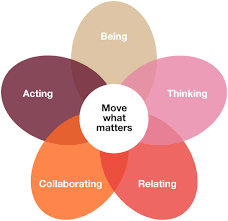
In his article ‘12 Principles for Reinventing the 21st Century University’, Otto Scharmer of MIT invites us to ‘reconceive the 21st-century university as a unity of research, teaching, and the praxis of transforming society and self.’
The principles in the article lean in on this perspective from ‘a bigger picture view: how to “update” the world’s educational system, particularly the university, to tackle the technological, environmental, and social disruptions of the 21st century.’ (Scharmer)
Otto offers: ‘what a 21st-Century University could look like if we upgraded the entire OS towards ‘vertical literacy’. The principles are not just a compilation of ideas. They are derived from two decades of hands-on experimentation and from participating in a global movement of learners and educators.’
That movement for vertical literacy unfolds and gathers momentum in teh global education ecosystem, even as you read this.
He goes in to say. It’s a movement focused on reinventing universities and schools as platforms for helping people and their organizations transform themselves and make the world a better place — by pioneering solutions that bridge the three major divides of our age: the ecological, the social, and the spiritual divide.’
In short he summarises that ‘the challenges of the world, and of societal transformation, are the curriculum. In turn the curriculum is for societal and personal transformation, and the enabling of collective capacity.’
I’ve always been curious about what learning experiences leverage the agency the collective capacity, and of diverse and multidisciplinary perspectives. From start-ups to SMEs and corporations, I didn’t see that collective creative and collaborative capacity functioning well in any organisation I worked in.
No one taught that in my education; or my daughters’ after me.
So I just started…copying and modeling on others; looking for the places where that type of education was being facilitated in HE institutions.
Prototypes and experiments we’ve run in Work in Progress (in the extra curricular space) tell us that from the student perspective at least, we can learn through experimentation, to facilitate deep enabling and transformative learning experiences:
‘This is the experience you’ve always needed even if you’ve never realised it. It makes you feel powerful and excited and capable. You work as a team; a community and you solve problems using all the skills you didn’t realise you have. It doesn’t matter what you do or what you know, this will make you better.‘
Work in Progress ‘Engagement Academy’ student participant Dec 2023
I wish I’d left education with that sense of agency; to navigate the ambiguity of my inner journey, and the outer journey into the work of the world.
My experiments in the learning arena are imperfect and iterative. I’m feeling my way. Connecting with colleagues experimenting in this space would be great to share ideas.
This article for me at least, articulates the potential of the Curriculum Transformation Project at Lancaster University. Its a moment to leverage existing excellence and best practice and explore or amplify ways to broaden and deepen ‘the learning cycle’ through expanding the curriculum focus to the ‘well-being of the entire city or ecosystem in which learners are embedded.’ (Scharmer)
For educators at Lancaster, the CTP may well well be ‘the biggest single leverage point of our time.’
Otto Sharmer’s piece on the principles for reinventing the 21st Century University is linked below.
It’s thought provoking.
 AmandaBrooks.me