
“Your real work is a spiritual endeavor… it’s an attempt to know the unknowable.”
Megan Macedo
When you surrender to uncertainty, you get deeper certainty by doing it.
It’s because when you just start, the journey to the adventure to the knowledge that alludes you can begin.
Eight or so years ago my question was about how we help learners understand the relevance to them of enterprise and entrepreneurship education as a skill for life, work and change, and how do we align this with career and personal and professional development for people for impact?
Its about changing a whole culture and landscape in education.
I’ve learned, that at the heart of every body of work is a defining question…or two or three.
These questions shift and change as we explore and dig deeper into our work; My early questions soon re-framed as I dug down into the good stuff to discover that somehow unleashing human creativity and creative confidence was at the root of understanding how to enable people to become creative problem solvers. Each new insight leads to new assumptions and questions to explore.
Here is a snapshot of mine right now, and current thinking around them drawn from people who know about this stuff, and emerging learning through things tested out… It only makes sense when you implement to learn through quick and dirty experiments.
Q: How might we uniquely contribute to preparing young people for the fast changing world of work and a fast changing, challenge driven world?
By curating learning environments where they can learn by doing to develop creative agency.
Q. How might we develop the creative agency of our learners to impact on individuals’ capacity to effect change in themselves, and their situation to support creative problem solving?
By curating opportunities for them to explore and develop their own ability to be creative in a problem solving context. (Self efficacy then propels them to change the environment to perform better as creative problem solvers with creative agency.)
These are the stages towards creative agency:
Personal / Internal – Self efficacy, creative processes…belief I can (individual, collaborative, multidisciplinary creative problem solving processes, experiencing design thinking as a user centered problem solving process; working initially on something generic; that you’re not invested in.)
Applied – Creative agency – applying creative processes and abilities; to real life challenges of self and others – e.g. youth social action, global challenges, enterprise challenges, through human centered design and entrepreneurship projects.
Outputs – Manifestation of creative Agency is generation of a body of work or evidence of performance in creative problem solving. e.g. outputs of workshops, projects or early ideas/developing ideas.
Impact – Effects of creative agency – body of work collides with the world to create value for self or others.
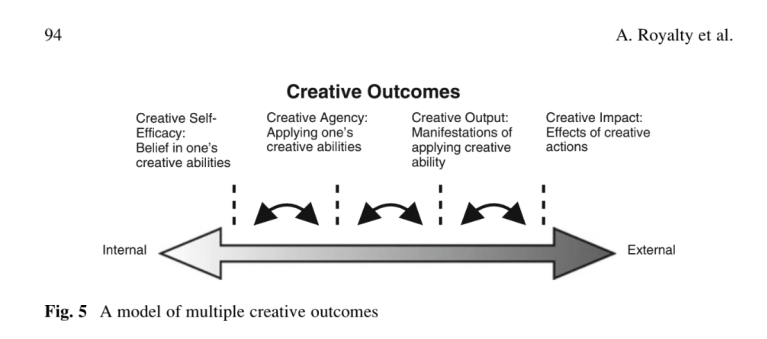
Q What competencies or mindsets do creatively confident people have that enable them to have impact out in the world?
Evidence from research paper – Royalty (Assessing Creative Agency)
- Comfort with seemingly negative states (failure / ambiguity)
- Bias towards action rather than reflective rationalisation
- Experience and learn design thinking processes and techniques
- Applying these skills and methods in life
- Applying these skills to launch career / change direction of career through prototyping
- Building creative environments in which to function
- Teaching colleagues creative processes and practices to facilitate better collaborations
- Brainstorming, idea generation and rapid prototyping to learn and build forward.
Q: What might the elements of a competency based creative agency scale be?
From research paper – Royalty (Assessing Creative Agency)
- Sources – ability to gather information externally
- Comfort levels with ambiguity
- Mastery – of ones own creative process
- Environment – creating effective creative environments
- Anti-perfectionism – reducing a sense that everything must me perfect
- Prototyping (culture of build to learn)
- Perseverance (increased in the face of failure)
- Facilitation (Confidence to lead a creative process)
- Openness (To challenges in thought, direction, beliefs etc.)
- Process (being able to describe one’s creative process
- Creative output – solving problems in creative ways
Q: What determines creative impact?
Creative output determines creative impact. Creative impact is the change made due to creative effort.
People with high levels of creative agency are capable of creative outputs in the form of real work, artifacts and ideas.
Self efficacy is the most important part of creative agency. It goes beyond belief in yourself and extends to real life problem solving.
Learning from others who are creative is critical in this learning journey.
________________________________________________________________________________________
Here’s one way to curate educational experiences that deliver this which is going global.
Here’s one not so quick, but dirty experiment we ran, which appeared to deliver creative agency for young people.
This is Educational Enrichment; Extending learning beyond traditional academic priorities to creativity and enterprise and entrepreneurship education and the development of self efficacy and competencies for individual and collaborative impact in a changing and challenge driven world.
A download about elements of a creative mindsets here.
To facilitate creative processes in others you have to practice and master it first yourself through hell bent trial and error, of the mindsets and processes to grow your creative confidence and agency. You have to master it yourself first; or at least start walking the walk…
‘You are your own work first’ (Megan Macedo)
Evidence of creative impact of our team’s work here – experiences for our learners to develop creative self efficacy – potentially belief in one’s creative abilities to design your life and have impact out in the world.
Amanda Brooks
 AmandaBrooks.me