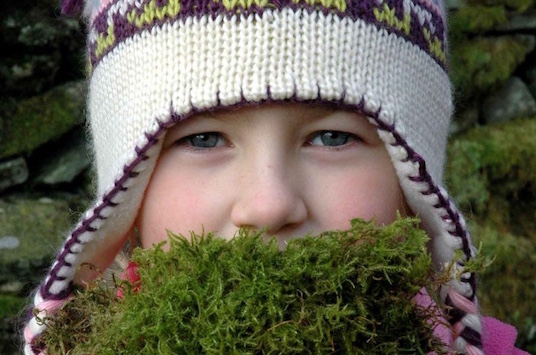
Without a creative role model Alys’ potential might have remained unearthed forever, in a linear education system that’s set to perform for metrics rather than inspire and nurture the natural talent of humans.
There is nothing like the despair of your own child to get you ‘going down and down, for the good turf. Digging.’ (Saemus Heaney)
It was 2011. My daughter Alys was standing in our kitchen looking down at her feet; despondent with tears pricking her eyes.
‘All the careers lady said today was that maybe I could be an Art Teacher, if I can get my maths GCSE. That was it. Whats going to happen to me Mum? I’m not clever. I’ll never get to university or get a proper job.’
Alys, who found reading and writing and numbers such a challenge yet immersed herself in imaginary play for hours, making and creating with things found, recycled and from nature; Alys who could paint, draw, and sing. The education system had left her feeling felt she had no potential; no future, no hope.
She was fourteen, choosing her subject options for GCSEs and had been withdrawn for a while. But there she stood, laid totally bare, vulnerable; she opened up to express her deepest held fears and beliefs about herself, for the first time.
‘Alys you have special skills, talents and superpowers that only you have. You’re creative; every one says so. Let’s explore how you can work with your strengths; your creative potential.’
It was the conversation I’d never had at her age with my parents. The system valued acadaemia above all else and parents followed the system.
She seemed unconvinced. ‘Creative’… just saying it had sparked a lot of yet to be fused connections in my head.
Thinking back to my own school days, my happiest memories were when I was lost in the big making rooms of sewing classes, woodwork and the tech drawing studio. I loved the practical stuff like typing because it seemed more useful and intuitive than algebra or Ohm’s Law. I was railroaded into dropping these subjects though, in favour of ones that paved the way to universities with ‘red bricks’. Polytechnics and following the yellow brick road were out of the question.
Fast forward a decade or two (or three and a bit). Masterclass speakers I’d listened to to in my work at The University, from the world of the creative industries, were holding up creative mindsets as the missing ingredient in graduates; in people, in companies.
The message was clear. The education system needed to generate more creative talent. It was needed across all disciplines…But how?
Creativity as a commodity in demand… pieces of my jigsaw, pieces of Alys’s and pieces of the puzzle about how to change Education or the better…but the picture was far from clear.
I grabbed a lap top, opened the craft cupboard and Alys and I started to explore. She filled in on line questionnaires and we researched the stories of the masterclass speakers. One was thrown out of the grammar school literally up the road from us, at age 16 with no qualifications. He had gone on to work closely with Mary Quant, later progressing to CEO of Pepsi Co and CEO Worldwide of Saatchi and Saatchi.
The other Masterclass speaker was one half of a creative husband and wife team, from Blackburn where Alys’s grandparents were born. Like Alys, Mrs had been a square peg in a misshapen education system; with immense creative potential. She left school with few qualifications in paper.
Yet together Wayne and Gerardine Hemingway went on to build an international fashion brand that still goes strong. Today they channel their passions, natural talents and the design process in to making a difference to the things that matter in life; an approach and a formula now being built upon by the next generation of the family. Further proof for Alys that that creativity has no boundaries.
These were stories about real people; Just being themselves, doing their creative thing; pursuing the things that felt most natural. In doing so they had unwittingly landed in business, grown an exciting brand, employed people around the world and most importantly, they had fun along the way.
We searched, printed, cut, glued and made a scrap book to make the stories tangible, relatable . Inspiration and role models. Hope; and a reframing for Alys of the possibilities for her future.
A long, happy hug. Body soft, not tense. Tired; relieved. ‘Thanks Mum I’m so glad we did this’.
We packed away the paper, scissors and left the scrap book open on the table. A reminder of the treasure we had unearthed.
I parked the metaphorical spade in the kitchen in the corner. There was more digging to to, more to unearth. More digging down for the good turf; For Alys, for me and for educational change.
Eight years on and Alys has graduated from The University of Northumbria in Newcastle with a BA Hons. Design for Industry. During her placement year she went on to work with some of the people in the scrapbook. She developed perspectives and had priceless experiences about what it’s like to live and work in a successful creative ‘business family system’ where people do he work they love.
Alys is still exploring what her real work is. Who isn’t? All we can do is the next ‘piece’ in our body of work to find our real work; but nobody tells you that. You’re meant to have the answers, or a plan, or just be willing to be an art teacher because no one can be bothered to put real people in front of you to show you what’s possible for someone like you.
And because of Alys I understand myself better. I’ve been on a creativity journey of my own exploring to understand what creativity is, and how ordinary mortals can re-find what they were born with naturally, but is knocked out of them by a system that classified people as creative and non-creative. Creative confidence….The ability to have ideas and put them into practical use.
I’ve been involved in various creative projects too because of Alys and her role models. I had fun dressing a statue with a bespoke tailored jacket, bringing entrepreneurs into the university where I work to tell their startup stories made my way to the d.School at Stanford University in the USA, to learn about design thinking education as a way to introduce technical creativity into challenge driven learning.
Role models and creativity are for everyone.and we need both to fuel the imagination of our young people in an education system that tells us there is one answer; the right one and that academia is everything.
Creativity and role models in every discipline out in the world, our young people need you. Enterprise education, entrepreneurship education and creativity will empower our next generation.
Metaphorical spade to the fore.
 AmandaBrooks.me